Truman Students Win Tech Competition After Creating Collision Detection System
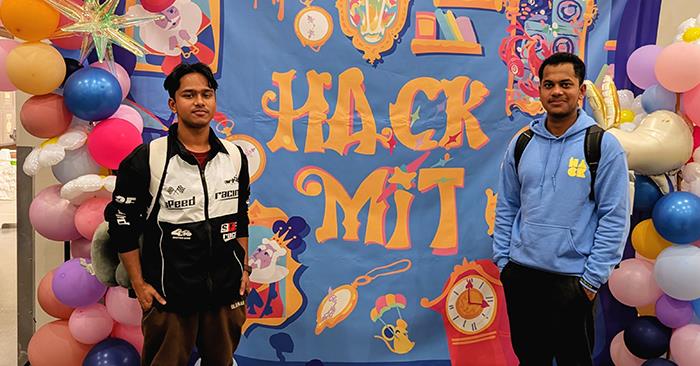
Tanvir Alam (left) and Ashraful Tutul competed at HackMIT at the Massachusetts Institute of Technology in Cambridge, Massachusetts.
Weekends can fly by, often with nothing to show for them. That’s not the case for Ashraful Tutul and Tanvir Alam who recently developed a way to neutralize the threat of space debris and keep $500 million satellites safe in orbit. They did this in a weekend. Just for fun.
Tutul and Alam won the SpaceXAI “Make it Legendary” challenge at the HackMIT competition in Cambridge, Massachusetts, Sept. 19-20. The event brought more than 1,100 students from around the world together to design and build innovative tech projects from scratch.
“A hackathon is an intensive technology competition where participants form teams and build a working project within a short period, usually over a weekend,” said Tutul. “Teams develop an idea, write the code, create a prototype and demonstrate it to judges. Despite the name, it is not about illegally accessing computer systems. The ‘hacking’ refers to creative and rapid problem-solving.”
The SpaceXAI challenge was one of the event’s major and most technically demanding categories. Teams were given the brief to build something using the AI coding platform Cursor as the integrated development environment, Grok Imagine for image generation and Grok Bot for project planning, as well as real space data.
“Beyond that, the problem space was ours to define,” Alam said. “SpaceXAI didn’t tell us what to build. They told us the tools to use, and we chose the mission.”
What Alam and Tutul ultimately created was Scutaris, a protective intelligence platform for orbital operations. The name comes from scutum, which is the Latin word for shield. It is also the name of a small but significant constellation that marks the Milky Way’s Scutum–Centaurus Arm and holds one of the densest star clusters known.
There are more than 11,000 active satellites, 40,000 tracked pieces of debris and 1.7 million untracked fragments, all moving around 17,000 miles per hour. A single collision can destroy a satellite and create thousands of new pieces of debris. Currently, operators manually check dozens of databases to figure out if their satellite is safe. It is a slow process and easy to miss a threat. Scutaris has the potential to analyze real data and return ranked collision threats visualized on a 3D globe. Every threat gets an AI-generated risk card, and a five-agent AI pipeline reasons through the situation to produce a validated avoidance maneuver in seconds. The whole pipeline runs end to end with real data, real search and real AI.
“What interests me most is the decision layer,” Alam said. “Most tools in this space hand the operator a table of data and say ‘you decide.’ Scutaris reasons about the threat and tells the operator what to do. That’s the piece nobody has really built yet.”
Scutaris is currently a hackathon prototype rather than an operational flight-safety system. Tutul and Alam would like to develop it further in the hope of creating a real-world tool.
“With further testing and validation, Scutaris could grow from a hackathon project into a research project or a practical decision-support platform for orbital safety,” Tutul said. “A more advanced version of Scutaris could help satellite operators monitor close approaches, receive real-time alerts, investigate high-risk objects and make better-informed decisions about possible avoidance maneuvers.”
While Tutul and Alam were solely responsible for creating Scutaris, they both acknowledge the role their Truman education played in their success.
“Scutaris was built during HackMIT, but many of the skills and habits that made it possible came from our experiences at Truman,” Tutul said. “Truman prepared us in ways we did not fully recognize until we were in the middle of the competition. Our computer science and data science classes gave us the technical foundation, but they also taught us how to break a large problem into smaller parts, test each part and keep working when something fails. That became extremely important at HackMIT because we had limited time and several parts of the project had to work together.”
Alam can also connect the dots of specific classes and instructors whose guidance helped hone their skills for the competition, but he knows each experience is part of a larger picture.
“Beyond the courses, the small classes at Truman are what gave me the confidence to walk into MIT and compete against students from much larger programs,” he said. “Truman made me feel like a serious engineer in such an interdisciplinary field, not a number in a lecture hall.”
Although ideas like Scutaris sound like something from the minds of advanced graduate students, Alam and Tutul are still undergrads who will not graduate until 2028 – Alam with a degree in data science and minor in astronomy, Tutul with a degree in computer science and a minor in data science. For now, they are focused on securing internships for next summer. While their win at HackMIT will certainly help in that effort, it also provided opportunities that are difficult to quantify.
“Participants came from 36 different countries. I walked away with friends from Imperial College London, Technical University of Munich, IIT Delhi, Barcelona, Beijing, Tokyo and Dublin, along with hundreds of MIT and Harvard students. That part of the experience stayed with me as much as the win itself.” Alam said.
Tutul and Alam won the SpaceXAI “Make it Legendary” challenge at the HackMIT competition in Cambridge, Massachusetts, Sept. 19-20. The event brought more than 1,100 students from around the world together to design and build innovative tech projects from scratch.
“A hackathon is an intensive technology competition where participants form teams and build a working project within a short period, usually over a weekend,” said Tutul. “Teams develop an idea, write the code, create a prototype and demonstrate it to judges. Despite the name, it is not about illegally accessing computer systems. The ‘hacking’ refers to creative and rapid problem-solving.”
The SpaceXAI challenge was one of the event’s major and most technically demanding categories. Teams were given the brief to build something using the AI coding platform Cursor as the integrated development environment, Grok Imagine for image generation and Grok Bot for project planning, as well as real space data.
“Beyond that, the problem space was ours to define,” Alam said. “SpaceXAI didn’t tell us what to build. They told us the tools to use, and we chose the mission.”
What Alam and Tutul ultimately created was Scutaris, a protective intelligence platform for orbital operations. The name comes from scutum, which is the Latin word for shield. It is also the name of a small but significant constellation that marks the Milky Way’s Scutum–Centaurus Arm and holds one of the densest star clusters known.
There are more than 11,000 active satellites, 40,000 tracked pieces of debris and 1.7 million untracked fragments, all moving around 17,000 miles per hour. A single collision can destroy a satellite and create thousands of new pieces of debris. Currently, operators manually check dozens of databases to figure out if their satellite is safe. It is a slow process and easy to miss a threat. Scutaris has the potential to analyze real data and return ranked collision threats visualized on a 3D globe. Every threat gets an AI-generated risk card, and a five-agent AI pipeline reasons through the situation to produce a validated avoidance maneuver in seconds. The whole pipeline runs end to end with real data, real search and real AI.
“What interests me most is the decision layer,” Alam said. “Most tools in this space hand the operator a table of data and say ‘you decide.’ Scutaris reasons about the threat and tells the operator what to do. That’s the piece nobody has really built yet.”
Scutaris is currently a hackathon prototype rather than an operational flight-safety system. Tutul and Alam would like to develop it further in the hope of creating a real-world tool.
“With further testing and validation, Scutaris could grow from a hackathon project into a research project or a practical decision-support platform for orbital safety,” Tutul said. “A more advanced version of Scutaris could help satellite operators monitor close approaches, receive real-time alerts, investigate high-risk objects and make better-informed decisions about possible avoidance maneuvers.”
While Tutul and Alam were solely responsible for creating Scutaris, they both acknowledge the role their Truman education played in their success.
“Scutaris was built during HackMIT, but many of the skills and habits that made it possible came from our experiences at Truman,” Tutul said. “Truman prepared us in ways we did not fully recognize until we were in the middle of the competition. Our computer science and data science classes gave us the technical foundation, but they also taught us how to break a large problem into smaller parts, test each part and keep working when something fails. That became extremely important at HackMIT because we had limited time and several parts of the project had to work together.”
Alam can also connect the dots of specific classes and instructors whose guidance helped hone their skills for the competition, but he knows each experience is part of a larger picture.
“Beyond the courses, the small classes at Truman are what gave me the confidence to walk into MIT and compete against students from much larger programs,” he said. “Truman made me feel like a serious engineer in such an interdisciplinary field, not a number in a lecture hall.”
Although ideas like Scutaris sound like something from the minds of advanced graduate students, Alam and Tutul are still undergrads who will not graduate until 2028 – Alam with a degree in data science and minor in astronomy, Tutul with a degree in computer science and a minor in data science. For now, they are focused on securing internships for next summer. While their win at HackMIT will certainly help in that effort, it also provided opportunities that are difficult to quantify.
“Participants came from 36 different countries. I walked away with friends from Imperial College London, Technical University of Munich, IIT Delhi, Barcelona, Beijing, Tokyo and Dublin, along with hundreds of MIT and Harvard students. That part of the experience stayed with me as much as the win itself.” Alam said.
