Truman Expands International Admissions Footprint
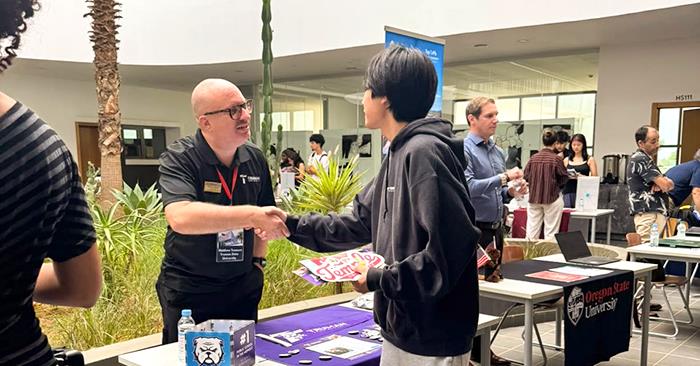
Truman is making adjustments to its international recruitment strategies in an effort to grow that population over the long term.
Matthew Treasure, assistant director of international admissions, recently visited Morocco, Egypt and Ethiopia where he represented Truman at recruitment fairs and visited secondary schools and university campuses. The trip was the second international one this calendar year, and part of a larger plan to have a consistent recruitment presence, as well as build and maintain relationships, in key markets.
“We’re deliberately diversifying our international recruitment strategy by expanding into markets where we haven’t previously had much of a presence and where student visa refusal rates may be more favorable by comparison,” Treasure said. “The goal is not to abandon our traditional recruitment markets, but rather to reduce our dependence on any one region while building relationships and increasing Truman’s visibility in new areas.”
Typically, international recruitment efforts have focused heavily on Asia, particularly China. Recruiters specifically choose these new areas based on data published by the Institute of International Education, with support from the U.S. Department of State’s Bureau of Educational and Cultural Affairs. It includes where international students are coming from, which states and institutions they are attending, their fields of study, and how enrollment patterns are changing over time.
Currently, two of the biggest hurdles facing international students are securing visa appointments in time for the start of the semester and obtaining visa approval once they have those appointments. Treasure points to English proliferation and economic growth in emerging markets as reasons to consider additional territories in the recruitment process.
“English is widely spoken and used as a language of instruction in many African countries, and we’ve encountered students with particularly strong English communication skills during our recruitment efforts,” he said. “In countries such as Ethiopia, Kenya, Ghana and Nigeria, many students have received substantial English-language instruction throughout their education. This can make these markets especially promising for Truman, as students with strong English proficiency may be better positioned to meet our admission requirements and transition successfully into an American university environment.”
For the 2026-27 academic year, Truman had slightly more than 200 total international students on campus. Between rising student visa refusal rates, difficulty securing visa appointments and uncertainty around proposed regulatory changes, as well as growing competition in Canada, New Zealand, Australia and European countries, American schools are facing significant obstacles in attracting and enrolling international students. Treasure is unsure how many students this most recent trip will yield, but he is hopeful Truman is positioning itself for long-term success.
“International recruitment is not simply about generating applications for the next admission cycle – it’s also about building institutional recognition and relationships in regions that may become increasingly important sources of international students in the years ahead,” he said.
International students interested in studying at Truman can learn more at international.truman.edu. To connect with an international admissions counselor, email intladmit@truman.edu or call 660.785.5395.

