Exchange Program Anniversary Highlights Value of Cultural Experiences
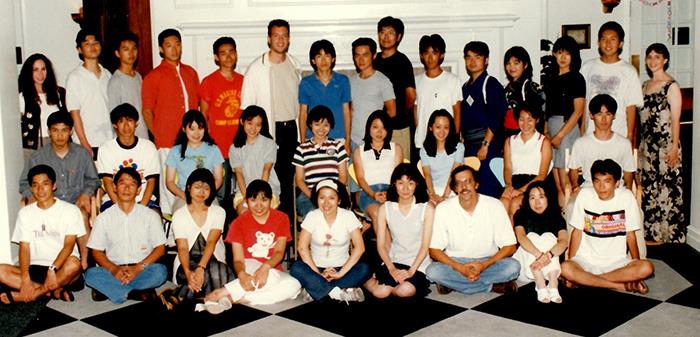
Visiting students from Hosei University assemble for a picture in the Student Union Building in 1996. Academic planner David Cicotello (first row, seventh from left) and student preceptors Marjorie Justice (third row, first from left), Todd Rohman (third row, sixth from left) and Laura Brewer Hakala (third row, end) were the Truman contingent responsible for hosting the students. Earlier this month Hosei University hosted a 30th reunion event in Japan.
College is a time for transformative experiences, and they can come in many forms – research, study abroad, internships, to name a few. For several years, Truman participated in an exchange program with Hosei University in Japan. While the prevailing wisdom with an exchange program is the transformative experience tilts disproportionately to the side of the visitors rather than the hosts, some of the Truman staff and students involved in the program 30 years ago know that’s not always the case.
David Cicotello came to the University in 1987 as an assistant professor of English, a role he maintained for six years. With his dissertation unfinished, he switched paths as an academic planning counselor in 1994. While in that role, he was recruited to serve as Truman’s leader of the Hosei University exchange program beginning in summer 1995. It was not necessarily something he sought out to do, but it nevertheless had an impact on him.
“This program brought me in contact with a group of international students for the first time in my academic career. Having never studied abroad, I was thrilled to be among the students and their leader in an intensive three-week program,” he said. “It broadened my world view, making me a better human being.”
Each year, the Truman-Hosei Exchange program welcomed about 20 students from each university to the campus of the other for a three-week experience. The students from Hosei typically visited in the summer. In addition to their English immersion classes at Truman, they took trips to various parts of U.S. for the complete cultural experience.
Cicotello was responsible for hiring Truman preceptors who lived in the dorms with the students, taught English classes and traveled on the excursions with them. Marjorie Justice was one of the preceptors. She remembers a riverboat cruise and exploring caves in Hannibal, Missouri, taking a tram to the top of Pike’s Peak in Colorado, and visiting the Denver Museum of Contemporary Art, as well as a walk around the rim of the Grand Canyon.
“We had so many adventures,” Justice said. “Our trip out west ended in a dinner in Flagstaff. I couldn’t stop crying. I knew how much I would miss all my friends. It’s amazing how much you bond through so many shared, incredible experiences.”
Laura Hakala, another preceptor, has similar recollections.
“I remember the group from Hosei University as playful and enthusiastic,” she said. “They wanted to do and see everything that we offered, and were just as happy to explain, describe and share their own culture and experiences with me. I remember the laughter and youthful antics typical of college kids. I made some great friends that were difficult to part with at the end of our time.”
Some of preceptor Todd Rohman’s memories come in the humor derived from the subtle differences in the visiting students’ expectations and the reality of their experience.
“During one of our long bus journeys, the students spotted a Denny’s on the side of the highway, sending a ripple of excited conversation through the group,” he said. “We obliged and decided to lunch there. They poured from the bus highly animated and into the restaurant, but as soon as menus were presented, a confused hush settled in. Apparently ‘Moons Over My-Hammy’ and ‘The Grand Slam Breakfast’ were not things in Japan. They were fully expecting a Japanese menu.”
Cicotello and all three of the preceptors from 1996 have maintained connections with each other, as well as with many of the Hosei exchange students from that summer. Considering their initial interaction took place long before the rise of social media, it speaks to the connections made during a relatively short time. Nowadays, it can be easier to maintain relationships from the other side of the globe.
“We connect via social media and exchange email messages and holiday cards,” Hakala said. “I have hosted a participant and his family in my home, and I connected with as many participants as possible when I visited Tokyo in 2000.”
It was through a social media message last year that Cicotello first learned of a 30th anniversary reunion taking place in Japan. This month, he travelled to Tokyo and met with students from the program he helped coordinate in 1996.
“Over my eight-day visit, my hosts organized a daily itinerary that included a Hosei University baseball game, a tour of The National Museum, a traditional sukiyaki dinner and trips to other cultural and spiritual sites,” he said. “I am grateful for their hospitality, generosity and friendship.”
Unfortunately, the three preceptors could only attend the reunion in spirit. Hakala lives in Northfield, Minnesota, where she is a student services coordinator for a non-profit organization that provides support services in higher education. Justice and Rohman were also unable to attend, but in fairness, every day is like a reunion for them. The couple married in 2001 and now reside in St. Louis where she is a content writer for a finance company and part-time instructor for the University of Missouri, and he is an English professor at St. Louis Community College.
For Cicotello, the 1996 reunion has a special place in his heart. That program was his last at Truman. The following December he accepted a position as director of new student orientation and first-year programs at the University of Nebraska-Omaha. He has also had positions at Middle Tennessee State University and The Webb School, a private preparatory school. He currently teaches English at Columbia State Community College.
“During my time with the Hosei-Truman exchange program, I gained valuable foundational experience in international education that served me well in my teaching and administrative positions,” Cicotello said.
Today, the Truman-Hosei Exchange program is technically still in existence, but current complexities of processing short-term visas make it difficult for Japanese students to visit. Truman did send a student to Hosei last fall, and it remains one of about 200 options to study abroad through the University. Despite the issues with short-term visas, Truman continues to have a robust population of international students on campus. This year, approximately 270 international students from nearly 50 countries are studying at Truman.
Truman students interested in studying abroad are encouraged to visit the Center for International Education Abroad in Baldwin Hall 106 or contact them at 660.785.7853 or studyabroad@truman.edu. More information can also be found on the CIEA website, studyabroad.truman.edu.

